Table of Contents
- Understanding Crypto Trading Risk Exposure
- Crypto Risk Management Strategies That Work
- Crypto Position Sizing: The Foundation of Risk Control
- How to Avoid Crypto Scams and Fraud
- Crypto Exchange Security: Choosing and Protecting Your Account
- Monitoring and Reviewing Your Risk Plan
- Frequently Asked Questions
Last Updated: October 18, 2026
Understanding Crypto Trading Risk Exposure
Cryptocurrency trading carries real financial dangers that go beyond typical investment risks. Most people focus only on price swings, but the actual threats are much broader. According to research on cryptocurrency inherent risks from the American Accounting Association, understanding how to interact with exchanges and confirming your cryptocurrency balances are critical steps to help mitigate risk.
The market moves fast and unpredictably. We've seen traders without a structured strategy take unexpected losses.
Your main risks include:
- Price drops that wipe out your gains in hours
- Exchange failures or hacks that lock you out of your funds
- Scams designed to steal your money or private keys
Crypto Risk Management Strategies That Work
Mitigate crypto trading risks by building a system before you trade a single dollar. The best traders follow a written plan, not gut feelings.
Your risk management strategy should cover five core areas:
- How much of your money you're willing to risk per trade
- When you'll exit a losing position
- When you'll lock in profits
- How you'll spread your money across different assets
- Whether you'll use borrowed money (spoiler: you shouldn't)
Each decision cuts losses and protects capital. Start with the first.
Step 1: Establish Your Risk Tolerance and Position Size
Position sizing is the single most important decision you'll make as a trader.
The rule: never risk more than 1-2% of your total trading capital on a single trade.
Losing streaks happen to everyone.
To calculate position size: start with total capital, multiply by your risk percentage (1-2%), and divide by how far the trade could move against you.
Example: You have $5,000. You're willing to risk 2%, so $100 per trade. You're buying Bitcoin at $45,000 and your stop-loss is at $44,000.
Step 2: Set Stop-Loss and Take-Profit Orders
A stop-loss order automatically sells your position when the price drops to a set level, removing emotion from the decision.
Set these orders the moment you enter a trade.
Place your stop-loss just below a support level or where it matches your risk tolerance, if you're risking $100, it sits where you lose exactly $100.
Your take-profit should be at least twice as far away as your stop-loss. If you risk $100 to make $200, that's a 1:2 risk-reward ratio.
$$ WINVEST $$ - START EARNING 3% DAILY FOR 60 DAYS NOW! →
| Strategy | Setup | Best For |
|---|---|---|
| Stop-Loss Order | Set 3-5% below entry | Limiting downside losses |
| Take-Profit Order | Set 6-10% above entry | Locking in gains automatically |
| Trailing Stop | Moves up as price rises | Protecting profits in strong trends |
| Guaranteed Stop | Pays small fee for guaranteed exit | High-volatility assets |
Step 3: Build a Diversified Cryptocurrency Portfolio
Don't put all your money into Bitcoin or a single trade. Spread capital across cryptocurrencies and trade types.
A basic diversified approach:
- 40% in established cryptocurrencies (Bitcoin, Ethereum)
- 30% in mid-cap coins with real utility
- 20% in smaller positions you're testing
If one asset crashes, the others keep you stable, these assets don't all move the same direction at once.
Step 4: Avoid Use and Margin Trading
Use lets you borrow money to trade with more capital than you have. It sounds like free money. It's not.
Example: You have $1,000 and use 5x use, controlling $5,000 of Bitcoin. Bitcoin drops 10% and your $1,000 is gone, the exchange closes your position. With no use, that same drop costs you $100 and you stay in the game.
Use is for professionals with strict risk controls. If you're learning, skip it.
Crypto Position Sizing: The Foundation of Risk Control
Position sizing determines whether you survive bad months or get wiped out. Beginners pick a size that "feels right", but it should be based on how much you can afford to lose, not how much you want to win.
Here's the professional approach:
- Decide your maximum loss per trade (usually 1-2% of your account)
- Identify your stop-loss price before you enter
- Calculate how many coins you can buy and still hit that loss target
If the math doesn't work, don't take the trade. This single rule protects you from 90% of trading disasters.
How to Avoid Crypto Scams and Fraud
Scams are everywhere in crypto. Research from the National Library of Medicine on cryptocurrency trading and mental health factors shows that tools to identify risky behaviors help traders protect themselves from fraud schemes designed to trigger impulsive decisions.
Most scam coverage stops at a list. That is not enough. The unique angle here is operational: how to verify before you send, how to recognize the social-engineering patterns scammers reuse, and what to do after money leaves your account.
The Scam Patterns That Recur
- Pump and dump schemes: A group accumulates a low-liquidity coin, hypes it across social channels, and sells into the buying pressure. The tell is a sudden coordinated burst of enthusiasm around an asset with thin order books.
- Fake exchanges and clone sites: A site mimics a real exchange's branding but captures your deposit. Verify the URL character by character and reach the exchange through a bookmark you created, not a link from an email or ad.
- Phishing and smishing: Messages that appear to come from your exchange asking you to "verify" credentials or approve a wallet connection. Legitimate exchanges do not ask for your password or recovery phrase.
Verification Habits That Prevent Losses
Before any deposit or wallet connection, run a short checklist:
- Verify the destination independently: Type the exchange URL yourself or use a saved bookmark. Don't trust links in messages, ads, or social posts.
- Check registration and disclosures: In the U.S., legitimate platforms typically have identifiable corporate entities, registered addresses, and regulatory disclosures. Their absence is a red flag.
- Test with a small amount: Send a small test transaction before a large deposit, and confirm withdrawal works before scaling up.
- Inspect token contracts: For new tokens, check whether liquidity is locked, whether the deployer can modify the contract, and how concentrated the holder base is.
- Slow down under pressure: Urgency is the scammer's primary tool. Any message demanding immediate action is a signal to pause and verify through a separate channel.
After the Money Leaves: Recovery Steps
Recovery is difficult but not pointless. These steps preserve your options:
- Document everything immediately: Transaction hashes, wallet addresses, screenshots, and timestamps. Exchanges, banks, and law enforcement require this record.
- Notify your exchange and bank: If funds moved through a regulated venue or bank transfer, notify them quickly. Some transfers can be frozen or reversed if caught early.
- Report to the FBI's IC3 and the FTC: File at ic3.gov and ReportFraud.ftc.gov. These reports feed broader investigations and are often required for later recovery.
The Behavioral Layer
Scams exploit emotion more than technology. The best defense is a personal rule set: never send assets to an unverified address, never share recovery phrases, and never let urgency override verification, a five-minute check is trivial compared with an irreversible loss.
Crypto Exchange Security: Choosing and Protecting Your Account
Exchange security is layered: where you hold assets, how you access accounts, and what you do when something goes wrong. Most traders focus only on the first layer and get caught by the second or third.
$$ WINVEST $$ - START EARNING 3% DAILY FOR 60 DAYS NOW! →
Custody: Exchange-Held vs. Self-Custody
When you buy crypto on an exchange, the exchange holds the keys, convenient, but it introduces counterparty risk: if the exchange freezes withdrawals, suffers a hack, or fails, your balance may be inaccessible. Self-custody means you control the private keys, removing that risk but shifting full responsibility to you, lose the keys or recovery phrase and the assets are gone.
Selecting an Exchange with Real Safeguards
Not all exchanges offer the same protections. Look for these concrete signals:
- Registration and oversight: In the U.S., exchanges may be registered with the SEC as broker-dealers or with state regulators as money transmitters. Check disclosures rather than trusting marketing pages.
- Proof of reserves and audits: Some exchanges publish third-party attestations of customer balances, not a guarantee, but a signal they're willing to be scrutinized.
- Cold storage practices: Most customer funds should be held offline. Published cold-storage ratios let you assess operational discipline.
Avoid exchanges that promise returns on deposits, lack identifiable leadership, or operate without regulatory registration. Those are structural red flags.
Account Hardening: Beyond 2FA
Two-factor authentication is the baseline, not the finish line. Use an authenticator app or hardware key rather than SMS, which is vulnerable to SIM-swap attacks. Also: use a unique long password stored in a password manager, enable withdrawal address whitelisting, turn on login and withdrawal alerts, keep a dedicated email for exchange accounts, and review active sessions and API keys regularly.
Recovery Planning: What to Do After a Compromise
If your account or device is compromised, the first hours matter.
- Contain: From a clean device, change your exchange password and revoke all active sessions and API keys.
- Secure email: Change your email password and check for forwarding rules or recovery-address changes an attacker may have added.
- Move remaining assets: If you still have access, transfer balances to a wallet you control. Don't wait for the exchange to resolve it first.
- Document: Screenshot unusual activity, save transaction IDs, and record timestamps, regulators and exchange support will ask for them.
- Report: Contact the exchange's security team immediately. In the U.S., you can also file with the FBI's IC3 and the FTC at ReportFraud.ftc.gov. For securities-related concerns, the SEC's investor complaint portal is another channel.
- Review the vector: Determine whether the compromise came from phishing, malware, a reused password, or an exchange-side breach. Fixing the vector prevents a repeat.
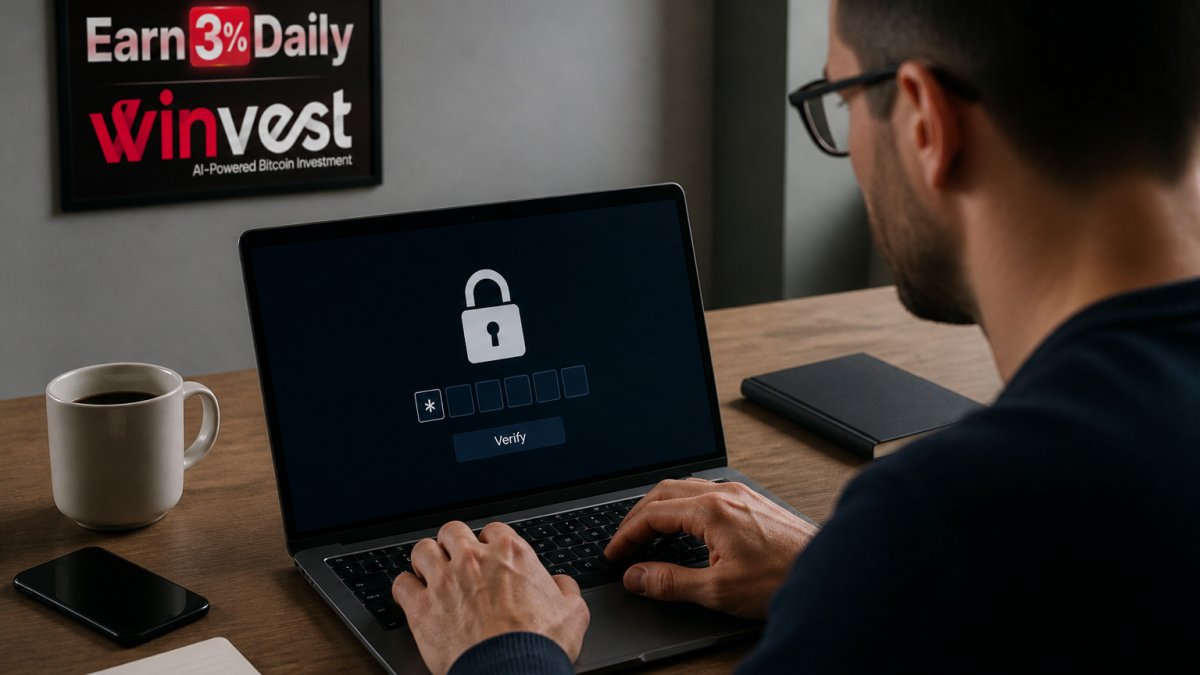
Exchange Failure and Withdrawal Freezes
Even a well-run exchange can freeze withdrawals during stress, and some have failed outright. Keep only trading capital on exchanges, diversify across venues if you trade actively, and test withdrawals before you need them. If an exchange announces delays, reduce exposure rather than treating it as a temporary glitch.
Monitoring and Reviewing Your Risk Plan
Review your plan every month.
If you win 60% of trades but lose more per loss than you win per win, your risk-reward ratio is wrong.
Mitigate crypto trading risks by treating your trading like a business, not a gamble. Start with position sizing. Add stop-losses and take-profits.
These steps won't guarantee profits. Markets are unpredictable. But they'll keep you in the game long enough to learn, improve, and build real wealth.
For a hands-off approach that removes emotion from crypto trading, Winvest offers an AI-powered platform with automated trade execution, transparent fund allocation tracking, and zero-fee withdrawals.
Frequently Asked Questions
What are the main risks of crypto trading?
Crypto trading involves multiple risk types: market volatility creates rapid price fluctuations that can erase capital quickly; leverage and margin trading amplify losses; liquidity risk means you may not exit positions at desired prices; exchange risk occurs if platforms fail or are hacked; and regulatory uncertainty can shift the legal landscape. According to research from the American Accounting Association, understanding how to interact with exchanges and confirming cryptocurrency balances helps mitigate these risks. A comprehensive risk plan addresses each category separately.
How can I reduce risk when trading cryptocurrency?
Start by sizing positions so no single trade risks more than 1-2% of your total capital. Set stop-loss orders to exit losing trades automatically and take-profit orders to lock in gains. Diversify across multiple digital assets rather than concentrating in one. Avoid leverage and margin trading unless you fully understand liquidation mechanics. Use regulated exchanges with strong security practices, enable two-factor authentication, and store most holdings in secure wallets. Review your risk plan monthly and adjust position sizes based on market conditions and your experience level.
How should I set stop-loss and position-size limits for crypto trades?
Position size depends on your account size and risk tolerance. A common rule is to risk only 1-2% of your total capital per trade; if your account is $10,000, each trade risks $100-$200 maximum. Set your stop-loss order at a price level where you're willing to exit, typically 5-15% below your entry depending on the asset's volatility. Calculate your position size so that if the stop-loss triggers, your loss equals your planned risk amount. For example, if you risk $100 and set a stop-loss 10% below entry, buy a position size where a 10% move equals $100. This ensures discipline and prevents emotional decisions.
How can I protect my crypto from scams and account theft?
Use only regulated exchanges that comply with financial oversight and maintain transparent operations. Enable two-factor authentication on all accounts using authenticator apps rather than SMS when available. Never share private keys, seed phrases, or account credentials. Verify URLs carefully before logging in to avoid phishing sites. Be skeptical of unsolicited investment opportunities or guaranteed returns. Research platforms thoroughly and check for official licensing and regulatory compliance. Store the majority of holdings in hardware wallets or cold storage rather than leaving them on exchanges. Regularly review account activity for unauthorized access.


No comments:
Post a Comment