Table of Contents
- What Crypto Trading Bots for Beginners Actually Do
- How to Set Up a Crypto Trading Bot: Step-by-Step
- Risks of Automated Crypto Trading You Should Not Ignore
- Crypto Trading Bot Tax Implications in the U.S.
- Types of Crypto Trading Bots: Grid, DCA, and Arbitrage
- Features That Separate Good Bots From Expensive Mistakes
- Choosing a Beginner-Friendly Platform
- Conclusion
- Frequently Asked Questions
Last Updated: September 20, 2026
What Crypto Trading Bots for Beginners Actually Do
Crypto trading bots for beginners are software programs that connect to a cryptocurrency exchange through an API and place buy and sell orders automatically according to rules you set. At Winvest, we build this kind of automation into a managed platform, so investors can put a strategy to work without writing a line of code.
How to Set Up a Crypto Trading Bot: Step-by-Step
Setting up a bot takes most people under an hour, and the process follows the same basic sequence whether you build it yourself or use a managed platform. The steps below assume you have never configured one before.
What You Will Need Before You Start
Gather these before you touch any settings:
- A funded account on a supported exchange
- A clear strategy (grid, DCA, or arbitrage)
- A risk limit you are willing to lose
- Two-factor authentication enabled on your exchange login
- A written record of your starting capital, so you can measure results honestly
Step 1: Connect the Exchange and Generate API Keys
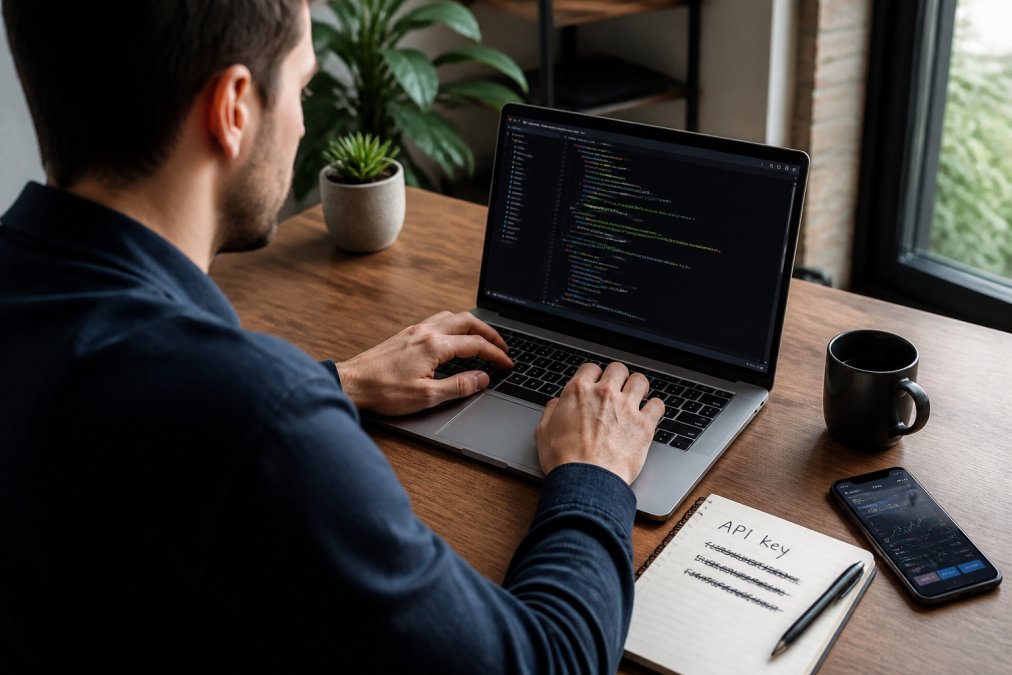
An API key is a digital credential that lets a bot place trades on your behalf without your login password. Generate the key inside your exchange account, then restrict it: enable trading permissions only, and never enable withdrawal access. Store the key somewhere encrypted, not in a plain text file.
Step 2: Choose a Strategy and Set Its Parameters
This is the step beginners rush, and it is the one that determines whether the bot makes or loses money. Each strategy has parameters you must set deliberately:
- Grid: the upper and lower price bounds, the number of grid lines, and the order size per line. Too many lines on a small account means fees eat the spread.
- DCA: the buy interval (daily, weekly), the fixed amount per buy, and the total budget you will commit. DCA has no exit rule by default, so decide in advance when you stop.
- Arbitrage: the minimum spread that justifies a trade and the maximum you will pay in fees. If fees exceed the spread, the trade is a loss before it starts.
Step 3: Backtest Before You Fund
Backtesting runs your strategy against historical price data so you can see how it would have performed before you risk real money. Run it in a paper trading or simulation mode first if the platform offers one, then confirm that orders fire the way you expect.
Step 4: How to Read a Backtest Before You Trust It
A backtest is a sales pitch until you interrogate it. Beginners lose money because they accept the headline number without checking the assumptions behind it. Look for these four things:
- Maximum drawdown: the deepest peak-to-trough loss in the test period. A strategy that returns 40% but draws down 60% is not one most beginners can sit through.
- Number of trades: a result built on a handful of trades is noise, not evidence. More trades over a longer period is more meaningful.
- Fees and slippage: many backtests ignore trading fees and the gap between the price you see and the price you get. Add both and the result often shrinks.
- Overfitting: if the strategy was tuned until it looked perfect on past data, it will likely fail on new data. A strategy that works across several different time periods is more trustworthy than one that works only on the last bull run.
Step 5: Start Small and Review
Fund the bot with an amount you can afford to lose entirely, run it for a few weeks, and compare live results against the backtest. If live performance diverges sharply from the test, stop and diagnose before adding capital.
Step 6: Secure the Connection
Once the bot is live, treat the API key as a password. Rotate it periodically, revoke keys you no longer use, and never share a key with a third-party tool you have not vetted. A trading key that can also move funds out of your account turns a minor security lapse into a total loss.
Risks of Automated Crypto Trading You Should Not Ignore
The biggest risk with automated crypto trading is not a broken bot. It is a bad strategy running perfectly.
Common mistakes beginners make:
- Testing a strategy with real money instead of backtesting it first
- Setting use higher than the strategy can survive
- Leaving a bot unattended for weeks without reviewing performance
Crypto Trading Bot Tax Implications in the U.S.
Crypto trading bot tax implications are the same as any other crypto trade: every executed buy, sell, or swap is a potentially taxable event, and automation does not change that. A bot can generate hundreds of transactions in a month, which makes record-keeping harder, not easier.
Types of Crypto Trading Bots: Grid, DCA, and Arbitrage
Three strategies cover most beginner setups, and each fits a different market condition.
| Strategy | Best Market Condition | Main Risk | Beginner Difficulty |
|---|---|---|---|
| Grid trading | Sideways, range-bound | Strong trends | Moderate |
| Dollar-cost averaging | Any, long horizon | Sustained downtrend | Low |
| Arbitrage | High liquidity, fast execution | Latency, thin spreads | High |
Features That Separate Good Bots From Expensive Mistakes
The features that matter most are backtesting, trailing stop-loss, take-profit orders, and a clear record of execution speed. Backtesting lets you run a strategy against historical market data before risking money. Trailing stop-loss adjusts your exit upward as price rises, locking in gains. Take-profit orders close a position automatically at a target.
Choosing a Beginner-Friendly Platform
A beginner-friendly platform removes the technical barrier between you and a working strategy. The right choice depends on how hands-on you want to be, but the evaluation criteria are the same either way.
The Questions to Ask Before You Commit
Most guides compare platforms on price and features. The questions that actually protect a beginner are different:
- Can I test before I fund? A platform without backtesting or paper trading is asking you to learn with real money.
- What are the API key permissions? Look for read-only and trade-only options, and confirm the platform cannot request withdrawal access. This is the single most important security question.
- How is performance reported? You should be able to see every trade the bot made, the price it got, and the fee it paid. A platform that shows only a headline return is hiding the details that matter.
- What happens when the market gaps? Ask how the bot behaves during a sharp move, does it pause, keep trading, or liquidate? The answer tells you more than any marketing page.
- What are the total costs? Subscription fees, performance fees, and exchange trading fees all come out of your return. Add them up before comparing.
Self-Managed Versus Managed
If you want to manage everything yourself, look for a no-code interface, a drag-and-drop strategy builder, exchange integration with major venues, and backtesting built in. Expect to spend real time learning the settings, and expect to make mistakes while you learn.
The Psychology of Letting a Bot Run
This is the part no comparison table covers, and it is where beginners do the most damage. The hardest skill in automated trading is not setting up the bot, it is leaving it alone.
A workable middle ground most practitioners land on:
- Define your intervention rules in advance. Decide now what would make you stop the bot, a drawdown limit, a strategy no longer matching the market, or a change in your own goals. Write it down.
- Review on a schedule, not on emotion. Check performance weekly or monthly, not every time price moves.
- Never override a single trade. If the strategy is wrong, change the strategy. Reacting to one trade is how beginners convert a plan into guesswork.
The right bot is the one whose strategy matches your market view, whose risk controls you understand, and whose results you can leave alone long enough to matter. A simple strategy you can explain, and resist tinkering with, beats a complex one you cannot.
Conclusion
Automation removes the time problem in crypto trading, but it does not remove the risk or the tax work. The investors who do well with bots are the ones who backtest first, restrict their API keys, and understand the strategy running under the hood.
Frequently Asked Questions
Can I make $100 a day trading crypto?
Some traders aim for $100 a day, but crypto trading bots do not guarantee daily income. Results depend on market conditions, the strategy you run, and the capital you start with. A bot using grid trading or dollar-cost averaging may produce small gains on active days and losses on volatile ones. Treat any daily target as a goal, not a promise, and only invest money you can afford to lose.
Are crypto trading bots profitable for beginners?
Profitability varies. Bots remove emotion and can trade 24/7, but they still follow the strategy you choose and the market they trade in. Beginners often see better results by starting with a small amount, backtesting a simple strategy like DCA, and tracking performance over weeks.
What are the primary risks of using automated crypto trading?
Key risks include market volatility, software bugs, exchange outages, and API key exposure. A bot can execute trades faster than you can react, which cuts both ways. You may also face drawdowns during a crash and tax reporting obligations on every profitable trade. Use API keys with trade-only permissions, never withdrawal rights, and keep most assets in cold storage.
How do crypto trading bot tax implications work in the U.S.?
The IRS treats crypto as property, so every profitable trade your bot makes is a taxable event. Short-term gains are taxed at ordinary income rates; long-term gains may qualify for lower rates if you hold over a year. Bots can generate hundreds of trades, so use crypto tax software or a spreadsheet to track cost basis. Consult a tax professional for your situation.
How much does a crypto trading bot cost?
Costs vary widely. Some platforms charge a monthly subscription, others take a percentage of profits, and some are free but limit features. Pricing depends on the exchange, the strategy type, and whether you need backtesting or API access. Check the provider's website for current pricing and read the fee schedule carefully before committing.
How do I choose a secure crypto trading bot platform?
Look for two-factor authentication, encryption, and API keys that can trade but not withdraw. Check whether the platform is custodial or non-custodial, and prefer non-custodial if you want to hold your own keys. Read independent reviews, test with a small deposit.


No comments:
Post a Comment